Introduction
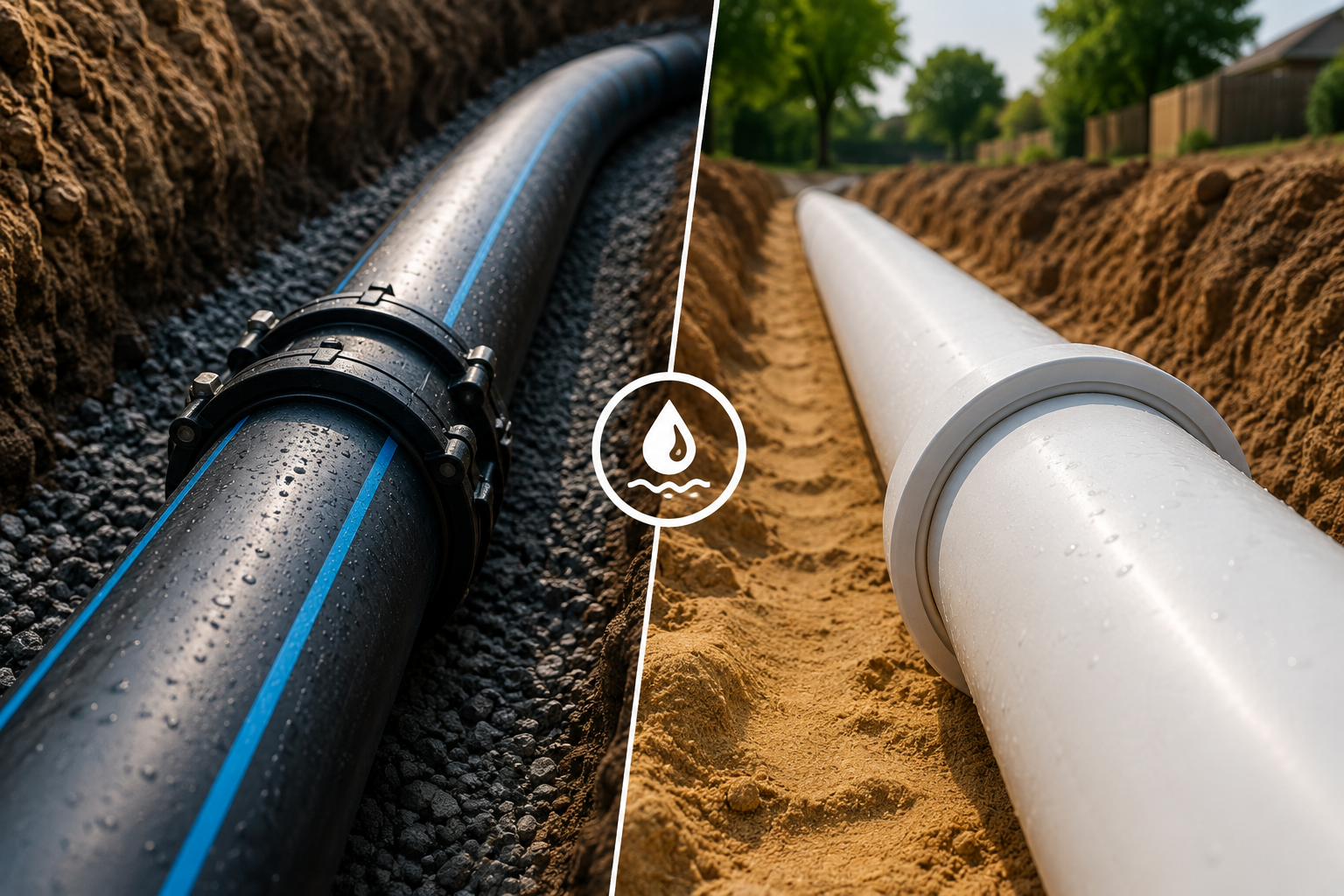
When it comes to plastic water mains, the choice usually comes down to two materials: HDPE (high-density polyethylene) and PVC (polyvinyl chloride). Both are widely used, both outperform older metal and asbestos-cement networks, and both have their advocates. But they behave very differently in the ground, and the difference shows up most clearly at the joints, under pressure surges, and over decades of service.
Quick answer
HDPE is jointed by fusion welding, creating a continuous, leak-free, fully end-load-resistant pipeline that flexes with ground movement and resists pressure surge and fatigue. PVC is jointed mechanically (gasket or solvent-cement), is stiffer and often cheaper per metre, but introduces a potential leak point at every joint and is more brittle, especially in cold conditions. For trenchless installation, ground movement, and long-term leak reduction, HDPE is generally the stronger choice. For straightforward open-cut work on a tight budget, PVC remains competitive.
The joint is the real difference
This is the single biggest distinction, so it is worth leading with.
HDPE is joined by butt fusion or electrofusion. The pipe ends (or pipe and fitting) are heated and fused into a homogeneous, monolithic joint. The result is a pipeline with no internal leak paths and full resistance to axial pull-out. [Internal link: “Electrofusion vs Butt Fusion: Choosing a Jointing Method”]
PVC is typically joined with rubber-gasket push-fit or solvent cement. These joints work, but every one is a discrete connection that can leak over time, and gasketed joints are not inherently end-load resistant, so they often need thrust blocks at bends and tees.
In a buried network, fewer joints and fused joints mean fewer places for water to escape. For utilities focused on reducing non-revenue water, that is decisive.
Side-by-side comparison
| Property | HDPE | PVC |
|---|---|---|
| Jointing | Fusion (butt/electrofusion), leak-free | Gasket/solvent, discrete joints |
| Flexibility | High: bends, coils, follows terrain | Low: rigid, needs fittings for direction |
| Surge/water hammer | Absorbs surge well | More sensitive to surge |
| Fatigue resistance | Excellent | Lower |
| Cold-weather brittleness | Stays ductile | More brittle when cold |
| Trenchless / no-dig | Excellent | Limited |
| Supply form | Coils (small dia.) and lengths | Lengths |
| Design life | 50 to 100 years | 50+ years |
Pressure surge and fatigue
Water networks experience pressure transients, or “water hammer”, every time a pump starts or a valve closes. HDPE’s ductility lets it absorb and dampen these surges, and it tolerates repeated pressure cycling well. PVC is more rigid and more sensitive to fatigue from repeated surges, which is why surge analysis matters more on PVC networks.
Installation and ground movement
HDPE’s flexibility is a field advantage. It comes in long coils in smaller diameters (fewer joints), bends around obstacles, and tolerates ground settlement and seismic movement without failing at rigid joints. It is also the material of choice for trenchless methods such as directional drilling, pipe bursting, and sliplining, because it can be pulled through the ground as a continuous string.
PVC installs quickly in straightforward open-cut trenches and is familiar to most crews, which keeps labour predictable.
Lifecycle cost, not just unit price
PVC can win on headline price per metre. But the fair comparison is total installed and operated cost over the asset’s life: joint count and leak risk, thrust-block requirements, repair frequency, and water loss. On long mains and on networks where leakage carries a real cost, HDPE’s fused, flexible system often closes or reverses the gap.
FAQ
Which lasts longer, HDPE or PVC?
Both are long-life materials. HDPE pipe is commonly designed for 50 to 100 years; PVC for 50+ years. Real-world life depends far more on installation quality and joint integrity than on the base material.
Is HDPE safe for drinking water?
Yes. HDPE grades certified to potable-water standards are used worldwide for drinking water mains.
Why do utilities increasingly choose HDPE?
Mainly the leak-free fused joints and the ability to install trenchless, which together cut water loss and disruption.
Konti Hidroplast manufactures HDPE (PE80 and PE100) pipes and a full range of fittings for water supply networks, in diameters from service connections to large transmission mains, all to European standards. Water supply product page · Request a quote