Introduction
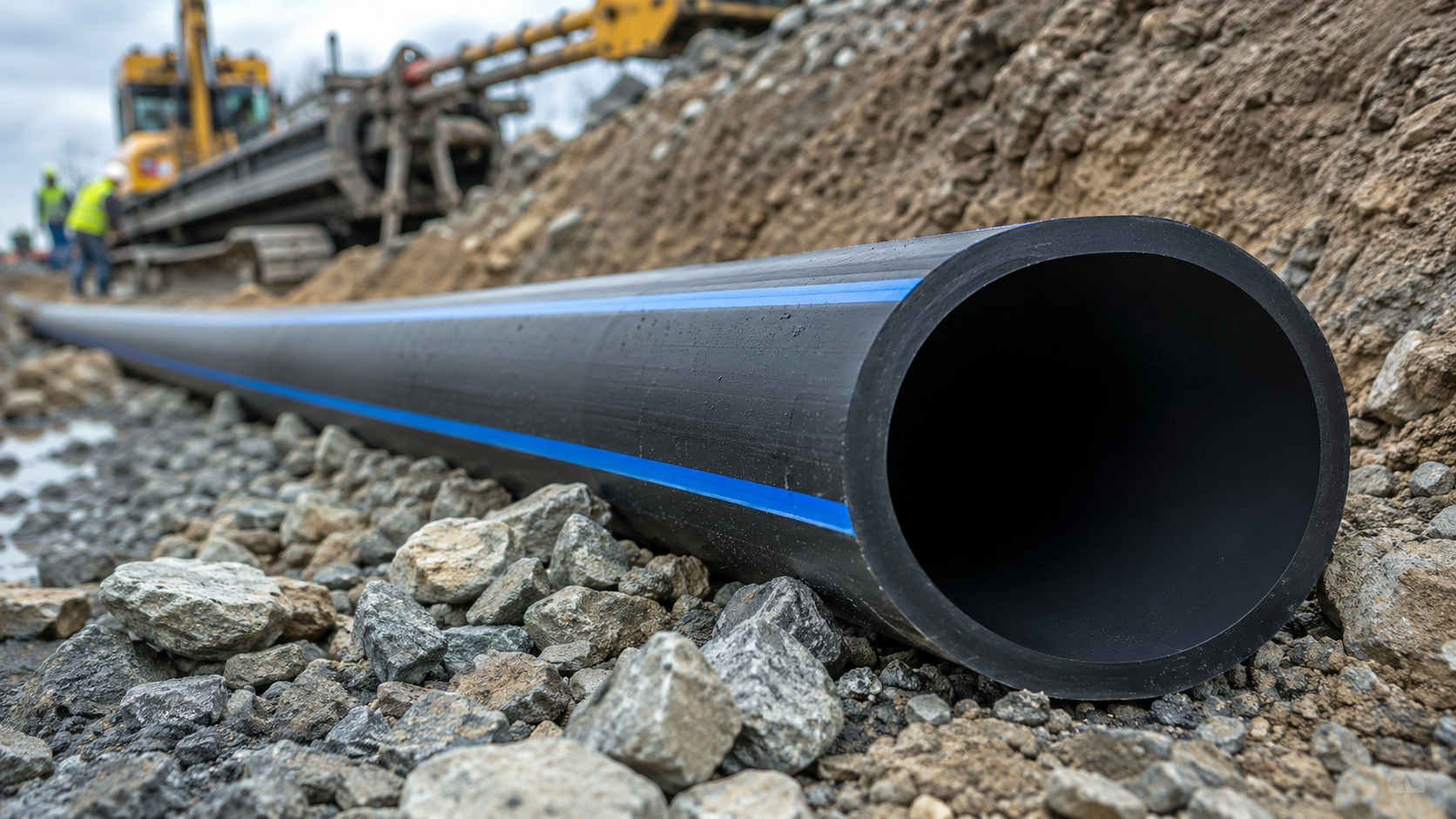
Standard PE100 is an excellent pipe material, but its long-term performance depends on being installed in clean, well-bedded conditions. The moment you introduce rocky backfill, point loads from stones, or trenchless laying that drags the pipe through the ground, you increase the risk of slow crack growth. That is the problem PE100-RC was designed to solve.
What “RC” means
RC stands for Resistance to Crack. PE100-RC is a polyethylene grade engineered for significantly higher resistance to two failure mechanisms:
- Slow crack growth (SCG): the gradual propagation of cracks under sustained stress, often starting at a point load or surface notch.
- Point loading: concentrated stress from stones or uneven bedding pressing into the pipe wall.
The base material still meets all the requirements of standard PE100 (MRS 10.0 MPa), so it carries the same pressure ratings. RC adds durability under mechanical stress. It does not change the pressure class.
Quick answer
PE100-RC is a polyethylene pipe grade with enhanced resistance to slow crack growth and point loading. It allows installation without a sand bed, in rocky or reused backfill, and via trenchless methods like directional drilling, pipe bursting, and ploughing, without compromising service life. Specify it whenever installation conditions are demanding or sand bedding is impractical or costly.
The three types (PAS 1075)
The German standard PAS 1075 classifies PE100-RC pipes into three types by construction:
- Type 1: a homogeneous PE100-RC pipe, RC material throughout the wall.
- Type 2: a coextruded pipe with an RC core and RC layers, offering additional protection.
- Type 3: an RC pipe with an additional protective outer layer (typically PP or PE), which shields the pressure-bearing wall from damage during trenchless installation and in aggressive backfill. The protective layer can be designed to be peelable or fused, depending on the product.
Type 3 is the most robust option for the harshest installation methods, because the sacrificial outer skin takes the abrasion and scoring while the inner PE100-RC layer keeps its integrity.
Why it matters: installation cost
The biggest practical reason to specify PE100-RC is what it lets you avoid. Conventional PE pipe usually requires importing clean sand to bed and surround the pipe, then carting away the excavated material. PE100-RC’s resistance to point loading means you can often:
- Reinstate the excavated material as backfill instead of importing sand.
- Use trenchless installation with no open trench at all.
- Lay through rocky or difficult ground with confidence.
On long runs and in urban environments, eliminating sand bedding and trench reinstatement is a substantial saving in cost, time, and surface disruption.
When to specify PE100-RC
- Trenchless installation: horizontal directional drilling (HDD), pipe bursting, sliplining, ploughing.
- Rocky, stony, or reused backfill where point loads are likely.
- No-dig urban projects where minimising excavation matters.
- Rehabilitation and renovation of existing pipelines.
- Any project where the long-term cost of a single crack failure outweighs the modest premium of RC material.
For standard open-cut installation in well-controlled bedding, conventional PE100 remains perfectly suitable. RC is about matching the pipe to a tougher installation.
FAQ
Does PE100-RC carry the same pressure as standard PE100?
Yes. RC enhances crack and point-load resistance; the pressure rating still follows the SDR, exactly as with standard PE100. Understanding SDR and Pressure Ratings in PE Pipes
Can I install PE100-RC without a sand bed?
That is the main reason it exists. Its resistance to point loading allows installation in the excavated backfill and via trenchless methods, subject to project conditions.
What is the advantage of a Type 3 pipe with a PP layer?
The protective outer layer guards the pressure-bearing wall against scoring and abrasion during trenchless installation and in aggressive ground, ideal for the most demanding jobs.
Konti Hidroplast manufactures PE100-RC-PP Type 3 pipe, a PE100-RC pipe with a protective PP outer layer for water supply, gas, and sewage pipelines, suited to trenchless installation and the renovation of plastic pipelines.